
What is Binary
What is “binary”?
Binary means two states or conditions. There’s no third candidate so the state must be either the first one or the second one. For example:
- a light is on/off
- a door is close/open
- you have finished/not finished your assignment
- today is/is not New Year.
All of them represent 2 opposite conditions in a certain situation. In the area of computer and machine, we use 0 and 1 to represent those two states.
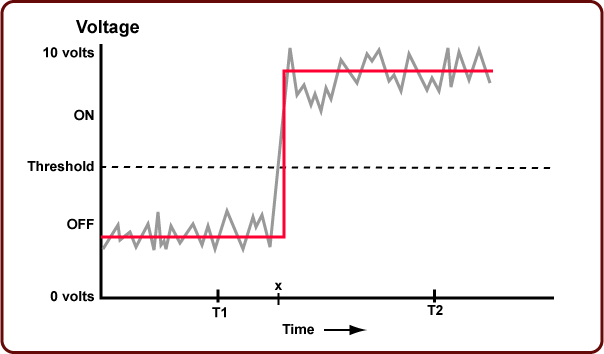
Take microprocessor for example, it can generate either high (1) or low(0) voltage.
Even there is some noise or bias when maintaining that voltage, the boundary between two states is so clear, that machine can distinguish them without making mistakes.
Why using “binary”?
Thus, we can summarise the advantages of applying binary digits:
- easy to build
- if there are three or more than three states, it is hard to identically distribute each state an accurate weight.
- For example, if three states are possible, that means you need to give each a weight of 33.33%
- immune noise or disruption
- two states are too different to mix them, although a relatively large noise exists.
- The info in binary format will remain clearly. You can also restore and then create a perfect copy of binary signals.
- can represent natural states
- most situations have two sides, that means you can represent them easily in binary format, and implement those into real machine execution
Reference
All articles on this blog are licensed under CC BY-NC-SA 4.0 unless otherwise stated.
Related Articles
2025-11-23
链式法则
链式法则应用于复合函数求导。如果函数是“一层套着一层”的,就要把函数像剥洋葱一样一层一层的剥开,再分别处理。直觉上,由于各层函数之间的影响是层层累积的,因此,所有的变化之间应该用乘法连接,来表示总的变化。这就是链式法则的内容: Chain RuleIf g is differentiable at x and f is differentiable at u, and y=f(u), u=g(x) then$$\frac{dy}{dx}=\frac{dy}{du} \frac{du}{dx}$$If there is more than two layers of functions, apply the rule repeatedly:$$\frac{dy}{dx}= \frac{dy}{du_{1}} \frac{du_{1}}{du_{2}} \dots \frac{du_{n}}{dx}$$where $y$ is function of $u_1$, $u_{i}$ is function of $u_{i+1}$, $u_{...
2026-02-16
线性代数再入门:基于Python的数学笔记
前言2023年7月,笔者刚刚结束中考,赋闲在家。彼时AI正大行其道蒸蒸日上,受网络氛围感染,笔者下载了若干电子书,试图用一个暑假来初步理解深度学习这一领域。然而,扑面而来的矩阵运算令我无所适从,阅读书籍更是举步维艰。经历了三年高中数学的学习与沉淀,笔者总算是鼓起勇气直面线性代数。 学习线性代数的基础不需要太深的数学功底,有初中数学基础,外加一点对于向量的理解完全足够。 这一系列笔记,都是学习过程中的随想随记,难免有错误疏漏或是理解不到位的情况。因此,笔者会不断修改更新完善所有的笔记,直到这些笔记能允许我在忘却一切的情况下快速重拾线性代数的相关知识。 创新点使用Python笔者注意到主流的教程中,很少有与计算机结合的;即使结合,也大多是Matlab等语言。诚然,Matlab集成了大量便捷的功能,极大的便利了学习与科研,但是它贵啊(且笔者不会啊) 这时,Python便再次出场了。不要忘记笔者学习线性代数仅仅是为了满足好奇心($\text{i.e.}$ 了解深度学习)。那么,为了能顺畅的由数学领域转移到计算机领域,使用Python可以说是最好不过的选择了,更何况它是开源免费的(且笔者略...
2025-10-14
Scope in Python
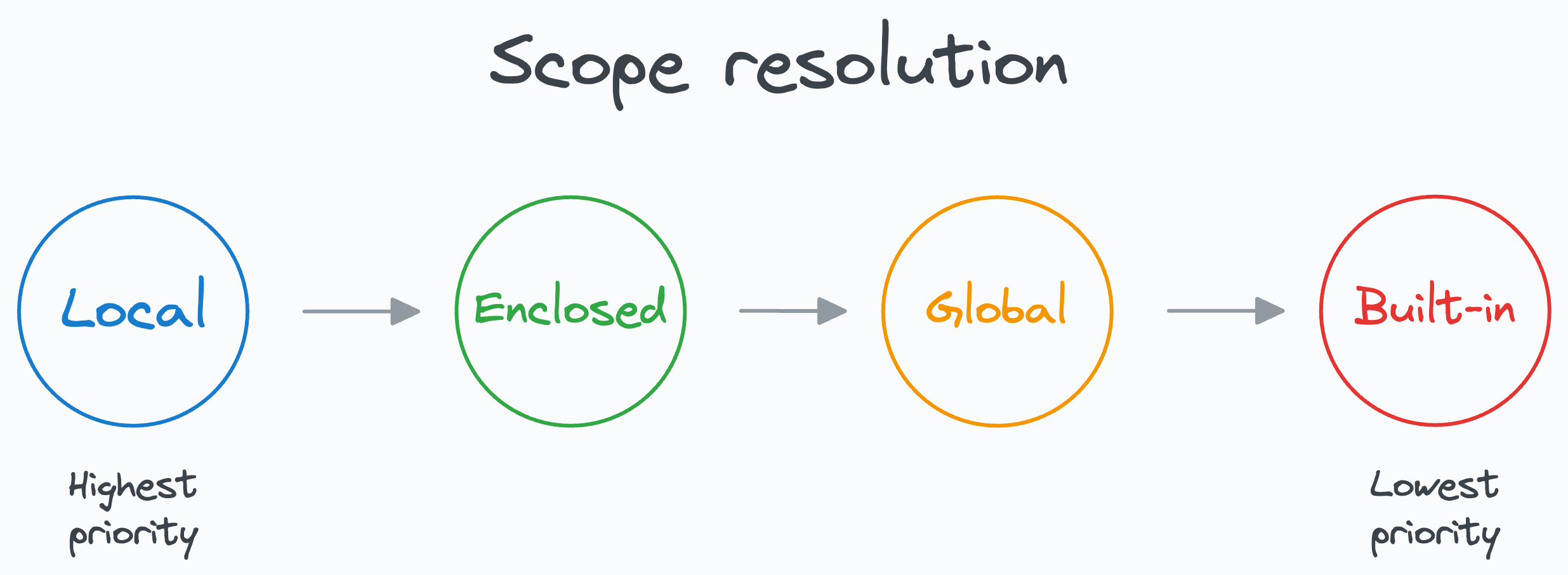
In python, scope means the domain that a variable can be used. In total, there are five kinds of scope in python: local scope, it means the variable is only defined in a function enclosed scope, it means the variable is defined outside the inner function, but inside the outer function global scope, it means the variable is defined through out the program built-in scope, it means some variables are set by some python libraries by default. comprehension scope, it is a special scope where vari...
2026-02-17
何为“线性”
咬文嚼字线性代数一词中,代数二字的含义不必多言。无论是初等代数还是抽象化的结构,其本质都是用普适的对象取代确切的数字本身,以寻求普遍的规律。($\text{e.g. 二次函数求根公式} x = \frac{-b\pm\sqrt{ b^{2}-4ac }}{2a}\text{就是一种普遍的规律}$) 那么,线性代数就应当是一门研究线性变换的规律的学科。 线性变换对任何一个对象进行线性变换,都要遵从两条铁律。放心,这两条规则实际上能帮助你简化问题 平直。也就是没有弯曲。线性变化前后,直线平面绝不可能变成曲面曲线,即研究对象被限制在了“一切平直的东西里”。 均匀。如果打开空间的网格线,那么线性变化前后: 网格线还是直线 网格线的间距还是一致的 原点不能动 言外之意,线性变换可以将空间旋转拉伸,但绝不会平移或扭曲空间。 代数上的形式更加简洁。对于一个线性变换$f$,其应当满足: $f(x)+f(y) = f(x+y)$ $af(x)=f(ax)$ 好眼熟啊,不是吗?你应当立刻联想到了好多东西: $f(x)=kx$ 一定是线性的!更进一...
Comments